Live · self-serve Beta · patent pending
We taught a 4-vCPU box to see like a VLM — without renting one.
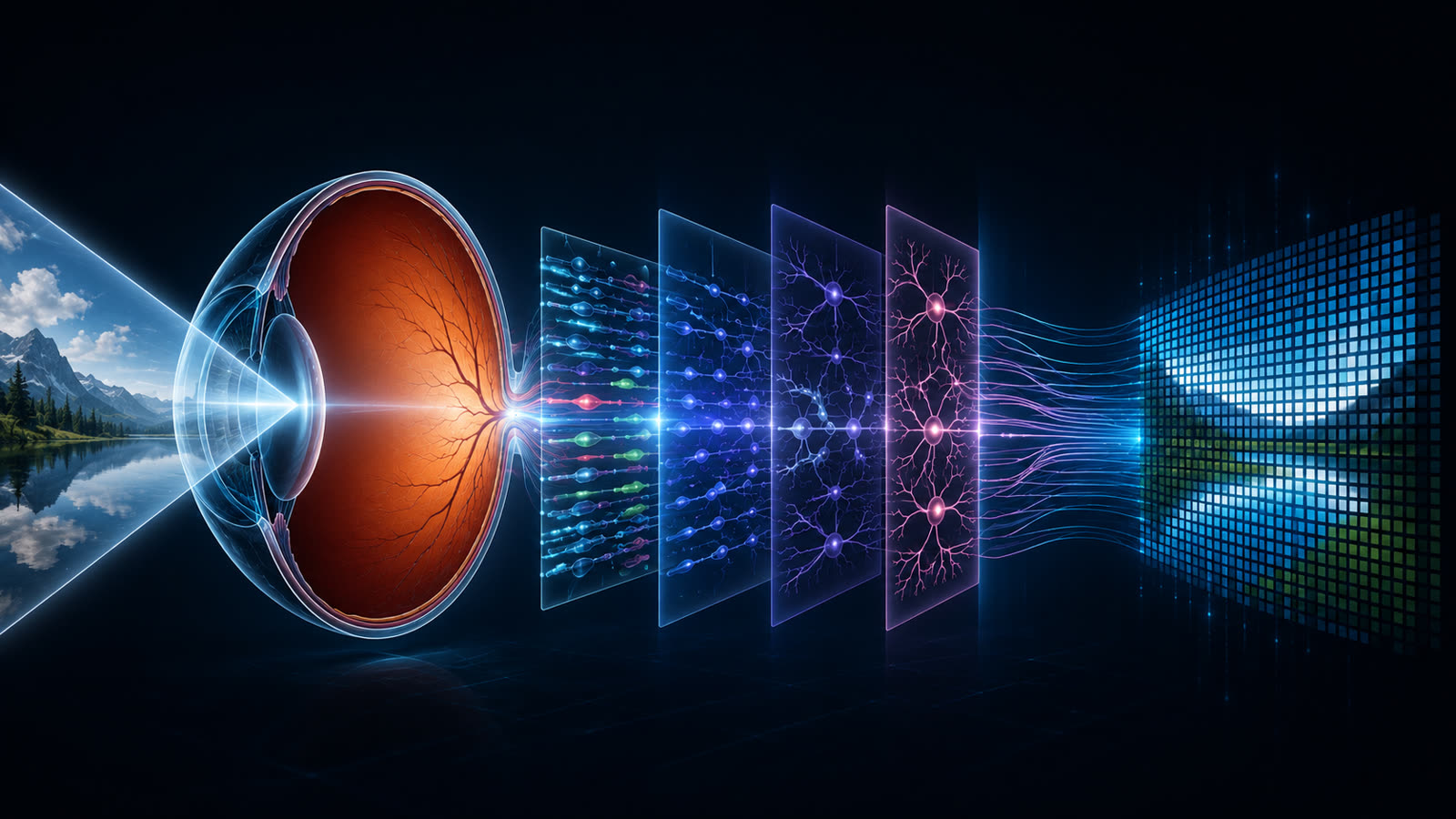
Digital Retina is a modular, VLM-near inference architecture that approximates the output of large vision-language models on commodity CPU hardware — a local pipeline with no GPU and no external VLM API. 92–95 % visual concept coverage (CLIP-lenient) and 70–87 % strict text coverage against Gemini 2.0 Flash and Llama-4 Scout, at 1.5 – 2 s per image.
visual concept coverage (CLIP-lenient), vs Gemini 2.0 Flash + Llama-4 Scout
images · two VLM oracles · 70–87 % strict text coverage
warm-worker p50 latency, 16 cooperating stages
cooperating neural / dynamical stages, 4 vCPU
What it does
Digital Retina takes an image and produces a structured noun-phrase description that approximates what a frontier vision-language model (Gemini, Llama-4-Scout, GPT-4V) would say about the same image — but on commodity CPU hardware, in 1.5 – 2 s, at a marginal cost below 10⁻⁶ USD per image.
The API has two surfaces: a Retina-native endpoint with full structured output (concepts, objects, OCR text, faces, scene type, dominant colours, fine-grained details, composition, and texture/pattern descriptors), and a Gemini-compatible shim that drop-in replaces google.genai's generateContent call.
It is deployed at retina.frank.ink as a free self-serve Beta — 50 images per API key per day, no credit card. Sign up with Clerk; receive an API key in 30 seconds.
Dictionary-growth ablation — coverage as the dictionary grows
Complementary ablation on a separate 47-image held-out set at the stricter threshold τ = 0.22 (the headline benchmark above uses the 44-image Gemini/Llama set at τ = 0.20). Five sequential rounds, each round's evaluation images strictly disjoint from the dictionary at the moment of evaluation. New oracle labels are appended after measurement, never before. Round 5 reaches 99.1 % on five previously-unseen images — the clearest single-round evidence that read-out generalises rather than memorises.
| Round | Dictionary size | Held-out images | Phrases | Coverage |
|---|---|---|---|---|
| 1 | 15 | 10 | 255 | 78.4 % |
| 2 | 25 | 10 | 262 | 81.7 % |
| 3 | 37 | 12 | 328 | 79.9 % |
| 4 | 47 | 10 | 239 | 82.8 % |
| 5 | 57 | 5 | 112 | 99.1 % |
| Σ | — | 47 | 1 196 | 82.4 % |
Threshold τ = 0.22 (realistic-FPR-corrected lower bound: 68.8 %). Two oracles: Gemini 2.0 Flash (rounds 0 — seed only) and Llama 4 Scout 17B via Groq (rounds 1 – 5).
Architecture, abstracted
Sixteen stages arranged as a directed acyclic graph fall into three classes:
- Perceptual stages — Off-the-shelf image-domain models (open CLIP family, COCO object detector, OCR, face detector + emotion classifier). Scalar similarities or structured detections.
- Compositional stages — Consume upstream outputs and re-score the image (or sub-regions thereof) under context-conditioned vocabularies. Produce phrases at finer granularity than whole-image scoring can.
- Emergent-pattern stages with learned dictionary — Transform the image into a low-dimensional signature in a structured dynamical system and read out by nearest-neighbour against a learned dictionary of labelled archetypes. Contribute texture, composition, atmosphere, and style descriptors.
The specific composition rules, signature definition, and dictionary mechanism are the subject of a pending patent application. Details are deliberately abstracted here pending prosecution.
What makes the measurements honest
01
Two independent VLM oracles (Google Gemini 2.0 Flash and Meta Llama 4 Scout 17B) supplied phrase-level ground truth across 62 images. Cross-oracle agreement provides a stability check that single-oracle protocols miss.
02
False-positive rate calibrated against *realistic* negatives — phrases drawn from other natural images of similar provenance — not just totally unrelated probes. At τ = 0.22 the realistic FPR is 13.6 %, yielding a corrected lower-bound coverage of 68.8 %.
03
Held-out images for each round were strictly disjoint from the dictionary at the moment of evaluation. No image was ever in the dictionary that scored it. Round-5's 99.1 % is on five novel images, not a lookup.
What this does not show
The dictionary is small (62 labelled images), seeded by two oracles, drawn from a relatively narrow image distribution (stock photography, AI illustration, traditional art, world architecture). Out-of-distribution behaviour on medical imagery, microscopy, satellite, industrial inspection, etc. is unmeasured and likely poor.
The coverage metric accepts substring, lemma, and decomposed-phrase matches; it does NOT test for correctness of compositional bindings. A tighter metric would lower the absolute numbers while preserving the relative ordering of architectural choices.
Hyper-specific named entities (proper nouns, branded text, named cultural objects) are the dominant failure mode and would require either OCR strengthening or dedicated entity-recognition stages. This is a coverage-scope limitation, not an architectural one.
Try it
Sign up. 50 images per day. Free during Beta.
Self-serve API keys via Clerk. Retina-native JSON or Gemini-compatible drop-in. Read the paper for the empirical case; bring an image to see the system answer.